
Public Cloud Solution Architect
Study Notes
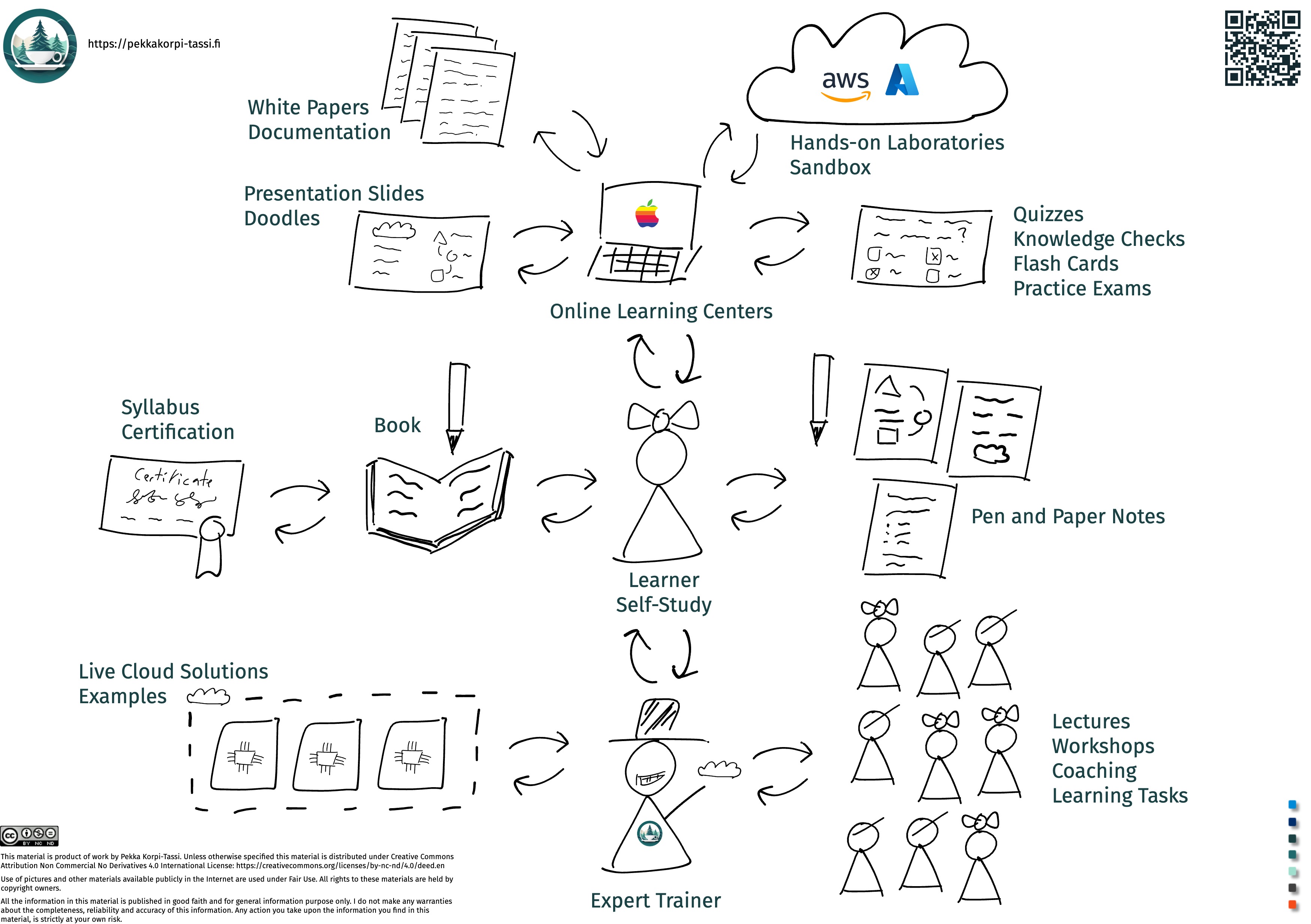
Public Cloud Solution Architect training teaches the learners relevant skills related to Public Cloud topic that are valuable in contemporary job market. For a learner it is critical to understand that learning Public Cloud topics requires time and effort. This is an important point to make to Public School students who may think that Public Cloud Solution Architect training is just another public school course. It is not, it teaches the learners as if they are professionals in work life. That is why learners are required to actively and incrementally create Study Notes about progress of their studies on Public Cloud topics:
Study Notes: The basic starting point for the studies is to take handwritten/freehand notes and to continuosly expand these notes during the studies to support the learning. There are 10 Themes in Public Cloud Solution Architect training so there should be set of 10 notes created and continuously developed during the studies. These study notes cannot rely on single information source, but require integrating information to the notes from multiple information sources.
For each theme of the Public Cloud Solution Architect training the learner must construct study notes. Study notes will be graded according to 50% scale. Study Notes will be submitted to Moodle learning management system. The recommended method for constructing the notes that facilitate the learning is described below.
Book: Every week learner is required to read from the chosen study book the chapter or chapters pertinent to the topics of the theme. The learner must take handwritten/freehand notes of the important learnings derived from studying the book. Notes should be free-form and contain mind maps and illustrations that help the learner to structure and visualize the information. Notes need to be annotated with important details about the issues addressed within! Learner should reserve some space in their study notes so that they can expand the information based on other source. So based on book the core study notes need to be formed and the notes must be iteratively expanded based on examining the topics further based on other sources.
If the learner has the moneytary means then it is recommended that they consider buying physical version of the preferred book. Physical book is an excellent companion to the study notes, because book can be underscored and annotated further and works great together with the study notes that contain mind maps and visualizations. The main books will set the learner back around 35EUR if they want to buy one. Two book options that are used during this implementation are:
- Book A: AWS Certified Solutions Architect Study Guide with 900 Practice Test Questions, 4th Edition
- Book B: AWS Certified Solutions Architect - Associate (SAA-C03) Cert Guide, 2nd Edition”}
Lectures: Because this is Public School Online Training there are trainer led sessions available during this course. Students should expand their study notes by including to them issues addressed during the trainer led sessions. It is a good idea to come to the trainer led sessions prepared by studying beforehand the relevant book chapter and other materials. It is very good idea to ask questions about unclear topics from the trainer during the trainer led sessions.
Learning Environment Content: The learning environments chosen for the Public Cloud Solution Architect training typically include resources such as presentation slides, videos or other documenetations. The learning environment resources - while usually good in quality - are NOT typically suitable to be the main study materials to learn the Public Cloud topics properly! Students should expand their study notes by including to them issues addressed in available learning environment materials.
Laboratories: There is a risk that the learners feel that they are doing laboratories “because they have to”. This is parly due, because they are learning tasks within the Public Cloud Solution Architect training, but true value of laboratories is to build hands-on experience about why and how to actually use the Public Cloud services! Students should expand their study notes by including to them issues addressed in laboratories.
Workshops: Because this is Public School Online Training there maybe trainer led workshops available during this course. Students should expand their study notes by including to them issues addressed during the possible workshops.
Knowledge Checks, Flash Cards, Quizzes and Practice Exams: All kinds of knowledge checks, flash cards, quizzes and practice exams are not optional part of Public Cloud topic studies. There are mandatory learning resources that the learners should leverage fully! The study notes should help the learner to answer to difficult questions in these knowledge checks and these knowledge checks are very good resources for fine tuning the study notes because they help the learners to reinforce their learning when investigating questions that they do know know answers to.
Assignment Submissions
Learner will submit their Study Notes to Moodle based on their self-evaluation of their Study Notes. Submissions are plagiarization checked and suggested similarity level is 0%-5%. Similarity level over 25% can be rejected. Similarity level over 50% suggests cheating and plagiarization. Learners will submit their Study Notes to Moodle based on their self-evaluation of their Study Notes. Learners will estimate each note as Basic, Average or Comprehensive for each of their Study Notes and submit their Study Notes to an applicable return box.
Guidance for self-evaluation is as follows:
- Basic: 1 Score for each basic note
- Handwritten/Freehand Study Notes about the book content is mandatory basic requirement.
- Study efforts may not be reaching all course learning objectives.
- Student has not identified key topics in the materials.
- Notes are superficial. Notes rely on general descriptions only. Notes may be limited in content.
- Effort: Study Notes demonstrate your work output from +/-4 hours of work.
- Outcome: Risk of not passing the course exam!
- Average: 1,5 Score for each average note
- Handwritten/Freehand Study Notes about the book content is mandatory basic requirement and notes include some additional Handwritten/Freehand or Typed/Multimedia content integrated to notes (lectures, learning environment, laboratories, lab comparison, workshops).
- Notes are taken, because student understand, that nothing can be learned without taking the notes. Notes indicate that students want to learn and makes the effort.
- Student has identified some important key topics in the materials.
- Notes show effort and some success in studies. Notes help to understand what services and technologies are and their common use cases.
- Important: It is recommended to annotate any pictures, diagrams or other materials with your own comments!
- Effort: Study Notes demonstrate your work output from +/-1 workdays effort.
- Outcome: Depending on success of the studies - if studies have succeeded - there is good chance of passing the course exam!
- Comprehensive: 2 Score for each comprehensive note
- Handwritten/Freehand Study Notes about the book content is mandatory basic requirement and notes include extensive additional Handwritten/Freehand or Typed/Multimedia content integrated to notes (lectures, learning environment, laboratories, lab comparison, workshops).
- Notes are taken so that student can use them as a basis for continued studies on cloud topics (Cloud Architecture 10 credits, Cloud Operations 10 credits).
- Student has identified key topics in the materials and has exhaustively documented details about these topics to support learning.
- Notes show deep unerstanding of topics. Notes indicate that students understand some specifics about why and how services and technologies are used.
- Important: It is recommended to annotate any pictures, diagrams or other materials with your own comments!
- Effort: Study Notes demonstrate your work output from +/-1,5 workdays effort.
- Outcome: Student wants to have an average or higher grade from the course exam and may even be aiming for cloud certification! Studies need to have succeeded, of course.
Important: Naming convention for documentation must be followed, or study note will not give any score for final evaluation! It is important to be honest and realistic in self-evaluation of the study notes! Trainer will check their self-evaluations and if there is consistent overestimation by a student related to self-evaluations for purposes of cheating or avoiding learning tasks then these Study Notes will be failed and provide 0 points for evaluation. Naming convention that is to be used is firstname_surname_self evaluation_theme id.file extension. Examples are given below:
- Basic: john_smith_basic_theme1.pdf
- Average: john_smith_average_theme1.pdf
- Comprehensive: john_smith_comprehensive_theme1.pdf
Once study notes have been reviewed and confirmed to be accepted at grade 1-5 by the trainer, the study notes will not be graded again.
Assignment Deadlines
Normal deadline for Study Note submissions is two weeks after the last lecture reserved for the theme! If learning tasks are submitted after normal deadlines they can be subtracted evaluation points.
Absolutely final deadline for Study Note submissions is the last calendar reservation of the course!
There are no late submissions beyond final deadline and there are no optional methods of completion for this assignment.
Handwritten/Freehand Notes
What constitutes as Handwritten/Freehand part of study notes?
- Pen and paper notes.
Typed/Multimedia Notes
What constitutes as Typed/Multimedia part of study notes?
- Tablet (iOS, Android and similar) and digital pen.
- Drawing table and digital pen.
- Markdown, Word, Powerpoint, Draw.io and other document formats.
- These contents are keyboard typed and multimedia content: text, pictures, diagrams and similar digital content.