
To enhance your experience and ensure the functionality of our website, we use certain technologies that require your consent. Please review the following and choose your preferred level of consent: Privacy Policy, Terms of Services, Disclaimer and License. This website optionally uses IP anonymized Google Analytics and may display Google AdSense ads to support the site's operation. We retain Log Data for 30 days.
I consent to all data gathering activities, Privacy Policy, Terms of Services, Disclaimer, and License.
I consent to only required data gathering activities, Privacy Policy, Terms of Services, Disclaimer, and License.
Showcase: 🧑💬+🤖💬 AI-Augmented Mentoring Experiment
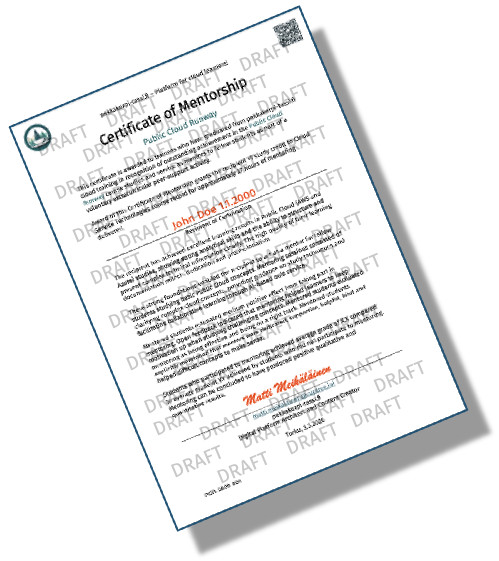
Certificate of mentorship was awarded to mentors!
Learning Public Cloud is highly recommended to all ICT professionals. However, even basic Public Cloud studies can be challenging for UAS learners. This is because studies are largely conceptual and involve many new concepts, terms and services. Language of ICT is English so if English is not the learner’s first language it can add to the challenges faced. Effective study techniques might not have developed during earlier studies, which may prevent learning job-market-relevant skills. Reading professional literature seems to be a novel thing too often! Why read at all, when you have AI? There were 2 articles recently in Iltasanomat 4.4.2026 and Kansalainen.fi 6.4.2026 about misuse of AI in colleges. Misuse of AI is not only a college, but also a UAS phenomenon. AI of course can have benefits as well as you will learn from this experiment.
Oh man, did you see that funny TikTok video where a dog eats a potato? Sorry, I got distracted, there are so many distractions these days. It seems to be quite challenging for many to focus on the task at hand. “But I want to be fast!” Stop it right there Buster, it takes time for a human to learn and it requires you to slow down, not speed up. Then what if things are unclear to a learner in a mass training online setting? Mass settings reduce the possibility of asking questions to trainers. Educational institution teachers are especially scary, because they have to assess whether learners have reached the learning objectives. And yet, despite all these contemporary issues, there still are learners that demonstrate persistence, actively engage with their work, document their learning and successfully achieve the learning goals. Could they play a part in creating more ICT professionals who can learn and work in the Public Cloud domain…?
Experiment Attribution: The showcased AI-Augmented Mentoring Experiment is a collaboration between UAS learners and pekkakorpi-tassi.fi. All original content and opinions expressed here belong to the author of this website. Experiences of mentors that participated in this experiment are shared with the permission from Mentor #1 and Mentor #2. The experiment is featured as an example of modern pedagogical innovation, learner peer support and possibilities of AI-augmented learning.
Keywords: Mentoring, Peer Support, Web Application, Quiz, AWS, Lambda, GenAI, DeepSeek
Published: 15.5.2026
ℹ️ Would you like to know more?
As I mentioned, basic Public Cloud studies are never as basic as they sound. Basic Public Cloud studies are mostly conceptual, with light exposure to hyperscaler technologies (AWS and Azure). Excellent study technique and foundational knowledge about Linux (bash) and Networking (Domain, DNS, TLS, IPv4, CIDR, OSI) is the starting point for learning Public Cloud concepts. If the mentioned prerequisites have not developed during earlier studies, then Basic Public Cloud training has to give opportunity to learn more about technical skills in context of Public Cloud.
Learning conceptual things requires that a learner be able to set the concepts into relationship with one another. This can only happen through the use of an external medium. Pen and paper are the basic starting point. Unfortunately, these basic embodied learning practices have in many cases atrophied, so Public Cloud training must facilitate development of study technique. Bringing back embodied learning practices helps Public Cloud learners learn effectively. But what if study techniques have not had a chance to develop? Well, I guess learning could happen through peers, who have developed effective learning techniques. Not to be too glib about it, but rediscovering embodied learning practices can be like cavemen discovering fire. Betty and Wilma are going to eat brontosaurus steaks tonight!
Public Cloud studying is often an online affair. This brings out an additional issue that during online or virtual learning learners have reduced possibilities to interact with the trainer to ask for clarification. Authority of the trainer can be intimidating. To ask is to expose your ignorance, learners might think, although 90% of the class might struggle with the same open question. So how to make trainers less scary? Well, it is not possible, but peers are easy to talk to.
So giving this context pekkakorpi-tassi.fi innovated a concept, where learners that have achieved outstanding learning results and have demonstrated an ability to process complex concepts on an external medium could act as peer-support for learners that are starting their Public Cloud journey. However, this was not the end of the story. We should not limit ourselves to what we know works from the tradition. With the advancement of GenAI new kinds of paths to explore creating eLearning solutions have emerged. Enter Quiz by pekkakorpi-tassi.fi eLearning service. It is practical AI based service that has the capability to generate Quizzes for any purpose, to enable users to run Quizzes and to have AI review and give guidance about the Quizzes.
If we named our multi-faceted pedagogical experiment, we would call it Framework for AI-Augmented Mentoring. An acronym FRAGMENT is appropriate, because it is the missing piece of support needed for Public Clour learning in a situation where UAS has no extra resources to spare. This seems to be a novel and unique contribution to higher education pedagogical domain, because no one had ever tried it before. Of course technical part of the experiment was not even possible before emergence of LLMs, and Quiz eLearning services are not a new thing in themselves, but implementation of technology combined with volunteer peer-support seems to be an original concept. Did the author of this website just invent a new pedagogical framework? 🤯 - ©️ 2026 Pekka Korpi-Tassi. All rights reserved.
AI-Augmented Mentoring experiment was run in spring 2026. Initially there were 5 learners with outstanding learning results from Public Cloud studies that expressed interest in sharing their study techniques and their knowledge with other learners. As is usual in volunteer work, there was some attrition among the initial group, but 2 mentor candidates came through and agreed to take part in the experiment. We agreed with the mentors that, since basic Public Cloud training has 10 modules, there would be 10 x 90 minute sessions where mentors could give peer support to new Public Cloud learners. UAS supported the experiment by agreeing to give mentors +1 study credit and certificate of mentorship for 27 hours of peer-support delivered to mentored learners.
There were enough mentors and mentored learners to form 2 mentoring groups. Not all learners who expressed interest in being recipients of peer support could be accommodated and some learners who did receive peer support did not participate in all mentoring sessions. Mentored learners participated in enough mentoring sessions that all 10 sessions were concluded. During mentoring sessions mentors answered learner questions about unclear topics, explained their study technique and ran AI-generated Quizzes collaboratively. Sometimes mentors did some preparatory work for the sessions for example recapping the contents of the modules in question or running Quizzes beforehand.
pekkakorpi-tassi.fi supported mentoring by developing and offering Quiz by pekkakorpi-tassi.fi eLearning service for the mentoring experiment free of charge. Quiz creation is semi-automatic and based on prompts so it takes some trial and error to make working Quiz content. Mentors had bank of 4 x 15 x 10 = 600 Quiz questions to use during collaboration with mentored learners. Experiences using the eLearning service caused the following updates to eLearning service (some of which have already been implemented, or will be implemented for fall 2026):
- UI tweaks
- increased feedback and pre-filled Google Search
- give feedback about wrong Quiz questions
- give feedback about correct Quiz questions
- adjust temperature and top-p inference parameters for Quiz generation and review
- create 3 tiers of Quizzes: accessible, average, challenging
- create separate practice Exams
- create separate AWS and Azure Quizzes
Mentors did not have to use Quiz by pekkakorpi-tassi.fi eLearning service during mentoring sessions, but it seems that most of the time they chose to. It is probably pretty interesting to do this kind of collaborative learning together. The true value of AI-Augmented Mentoring comes from the collaborative problem solving and discussion, not from the eLearning service itself. Memorizing Quiz answers does not lead very far, but collaboration leads to true learning. Mentoring groups could also use official AWS-provided or Sybex-provided practice exams as they had access to these resources.
Mentored learners estimated medium-level positive effect from taking part in mentoring. Open feedback from the mentored learners indicated that the arrangement helped to keep learner motivation high while studying challenging concepts. Mentored learners explicitly mentioned mentoring experiment being effective and being on the right track. Mentored learners felt that the mentors were dedicated, supportive, helpful, kind and that they helped difficult concepts become clearer.
In scope of mentoring experiment we are eventually talking about single digits of learners. Hopefully in the future participation to mentoring experiment could be expanded. Data gathering from the mentoring experiment needs some work so that results can be more reliably analyzed and interpreted. Peer-support delivered by the mentors can be concluded to have generally produced positive results to mentors themselves and to mentored learners. One tangible observation from this mentoring experiment was that there are 2 types of learners who can benefit from mentoring:
- Learners who want to meet the highest standards and achieve high course grades.
- Learners who want to overcome barriers to learnings.
Outcomes from the mentoring experiment where learners reached high course grades are certainly partly result of self-selection by the most capable learners, but there is little doubt that mentoring can improve the learning results of all participating learners. By how much? Ultimately it depends on the activities of the learners themselves, not the mentors. It is interesting that in this mentoring experiment there were no clear middle-of-the-road type learners.
Limitation to creating mentoring groups is the availability of mentors. If there are several mentors, different kinds of mentoring groups can be formed. Because of natural attrition among mentored learners during the mentoring period mentoring groups need to have enough members. Ultimately mentoring groups are largely defined by the schedule set by mentors. Remembering this is voluntary peer-support for the mentors, their time and contribution must be respected and valued. During this experiment mentoring happened mostly online, but nothing would prevent mentors from organizing mentoring onsite.
Mentor #1 felt that 1 study credit for 27 hours of mentoring services delivered seemed about right. However, they mentioned having spent 60-90 minutes with each module on recapping content, but felt this was ok as they were planning to take CLF-C02 certification examination anyway. Mentor #1 described their mentoring sessions having been very active and that there was lively discussion ongoing during sessions where everyone was learning from everyone. Mentor #1 had previous mentoring experience as well, which was pretty great and probably contributed to their decision to volunteer their time.
Mentor #2 described having spent 60-90 minutes with each module recapping content. They described that more challenging modules required more thinking, explaining and analysis of Quiz questions. Mentor #2 observed - and this is the point of the whole mentoring affair - that they found discussing Quiz questions collaboratively to be more effective than focusing on correct answers alone, as it encouraged deeper understanding. Funny observation on the other hand is that the most requested feature to add to Quiz eLearning service was to include correct and wrong answer options to Quiz review, which may lead specifically to short-term memorization learning strategy we want to avoid. Service now does give analysis also on correct Quiz answers.
Mentor #2 mentioned that one notable feature of their mentoring was clarifying concepts underlying the cloud concepts. This meant virtual machine, networking and other ICT terminology. Based on this observation Mentor #2 worked to simplify underlying concepts and connect them to practical examples. One direct update to Quiz service based on Mentor #2 feedback was the inclusion of fourth accessible set of Quiz questions to all 10 modules to support mentoring related to basic issues. From author’s perspective Mentor #2 made a big contribution to explain base level concepts to help mentored learners to overcome unfamiliarities with baseline concepts.
Mentoring is a voluntary and optional activity and mentors and the mentored learners need to find the time to arrange and take part in mentoring sessions. Both Mentor #1 and Mentor #2 have likely contributed more than 27 hours of work towards mentoring, which did not seem to burn them out, but it is important to make sure mentors do not overburden themselves when taking up this responsibility. However, learning potential for individuals - the mentors and the mentored learners - can be notable.
In conclusion AI-Augmented Mentoring experiment produced valuable experience on how AI-Augmented Mentoring can be implemented in practice and how it can be developed in the future. The experiment validated the concept and showed potential for improved learning results with Public Cloud studies. It is important to note that arranging mentoring is limited by the persistence of mentored learners and by the fact that mentoring cannot be a mandatory part of UAS training and cannot be enforced. It is likely that the ability to expand mentoring participation could lead to better academic and learning results. Experiment is planned to continue in fall 2026 with at least 2 new mentors recruited from the Basic Cloud training group that took part in mentoring experiment!