
To enhance your experience and ensure the functionality of our website, we use certain technologies that require your consent. Please review the following and choose your preferred level of consent: Privacy Policy, Terms of Services, Disclaimer and License. This website optionally uses IP anonymized Google Analytics and may display Google AdSense ads to support the site's operation. We retain Log Data for 30 days.
I consent to all data gathering activities, Privacy Policy, Terms of Services, Disclaimer, and License.
I consent to only required data gathering activities, Privacy Policy, Terms of Services, Disclaimer, and License.
Showcase: 🧪 Student Onboarding Platform
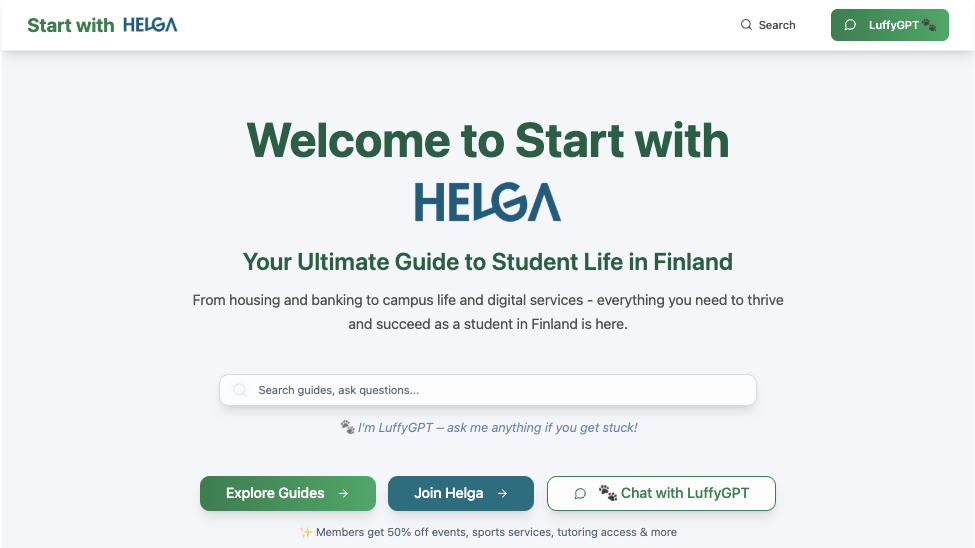
Source: Helga 2026.
In here is another interesting case from a University of Applied Sciences learner who experienced challenges in accessing information as an international student moving to Finland. This project was an entrepreneurial initiative to bring together essential information for international students under a single portal. The author of this project identified a problem and proceeded to concept, implement and deploy an onboarding portal which was adopted into use by the student association. In addition to the technical implementation, the project included extensive end-user interviews and close collaboration with student tutors to test and validate both the platform and its content.
Project Attribution: The showcased project is the work of a learner. It is showcased on pekkakorpi-tassi.fi with the permission from the Author of the Project and from Student Union Helga.
Keywords: Managed Hosting (DNS, TLS, CDN), 3-Tier Web App, React, Supabase, PostgreSQL, Keyword-Based Routing
Published: 20.4.2026
ℹ️ Would you like to know more?
Service Abstraction Level of this Project:
- Physical Server
- VPS
- IaaS
- PaaS
- BaaS
- FaaS
- SaaS
This project showcases a quite common lifecycle of a software-based product from concept to POC to MVP that could be taken into production use. It is not to say, that product would be incomplete, but to outline that in modern software development we want rapid innovation and deployment to production to validate whether the product is delivering value to the target audience. The technical foundation of this project is 3-Tier Web Application built on Supabase BaaS.
We are used to think service abstraction levels on IaaS, PaaS and SaaS levels, but service abstraction level is a more broad spectrum, and this project outlines to us less-talked about service model called BaaS (Backend as a Service). To understand what BaaS is, is to understand Supabase, which is a platform or stack than can be used to handle backend (AuthN, AuthZ, API) and database implementations where startup-like speed and rapid deployment is required allowing developers to focus on frontend and content. It is very beneficial to review some information about Supabase:
The product of this project is The Student Onboarding Platform Start with Helga, which is in the production usage at the time of writing this showcase.
A lot of focus in these kinds of MVP style products goes into development of the product itself. In this case the product is the platform and the content. In here the author has been developing both. In longer term, the platform and the content might be separated, as one is managed in version control and other is managed in some type of file storage with possible end-user user interface support. In here the author has cleverly managed their available resources and outsourced the backend building to Supabase and infrastructure management to a website hosting service, which works well in the context of this project.
This showcased project highlights the ability to:
- Identify a real user problem through lived experience and direct interviews
- Turn user feedback into iterative product improvements
- Build stakeholder trust incrementally to take project from concept to a formally acquired platform
- Learn and apply required technical skills to work from a clean slate to a working technical product
- Make decisions on what to focus on to rapidly implement and deliver value to end-users
Inspired by this project let us consider the lifecycle of software-based products more broadly. As a software-based product evolves it might go through lifecycle phases such as these…
🧪 Prototype Stage
- Brave sould experimenting to verify if an idea can work at all.
- Mindset: “Can this even work?”
- Product: Improvised / fragile
- Work Management: Skunkworks / side-of-desk
- Tooling: Disconnected tools (Excel, scripts, local tools)
- Automation: None
- DevOps: None
- Cloud: None
- Chore: Manual orchestration across tools
🌱 Early Stage
- One person does all work (building, deploying, fixing, deciding).
- Mindset: “Just get it running!”
- Product: Fast
- Work Management: Ad hoc, reactive
- Tooling: Fragmented, minimal
- Automation: None
- DevOps: Almost nonexistent
- Cloud: Minimal / bypassed (VPS, colocated server)
- Chore: Everything
🌿 Growth Stage
- Constant patching issues while trying to move forward.
- Team: Single pizza team + roles evolving
- Mindset: “Add cloud to fix pain points!”
- Product: Demanding
- Work Management: Emerging structure
- Tooling: Expanding but inconsistent
- Automation: Some scripting and integrations start to appear
- DevOps: Lagging behind
- Cloud: Partial / hybrid (mix of VPS + managed services)
- Chore: Manual fixing and deploying
🔥 Crisis Stage
- Most effort goes into stabilizing production and responding to incidents.
- Team: Two pizza teams + roles overlapping
- Mindset: “We need to fix this now!”
- Product: Breaking
- Work Management: Overloaded & reactive
- Tooling: Heavy but underutilized
- Automation: Ad hoc CI/CD, inconsistent
- DevOps: Catching up reactively
- Cloud: Rapid/forced adoption (but unstructured)
- Chore: Firefighting
🌳 Mature Stage
- Handling incidents, dependency updates and quality requirements as part of a controlled system.
- Team: Structured cross-functional team with clear ownership
- Mindset: “Design for scale and reliability!”
- Product: Structured
- Work Management: Structured & aligned
- Tooling: Integrated, intentional
- Automation: Mature CI/CD
- DevOps: Enabler, not bottleneck
- Cloud: Cloud-native & intentional
- Chore: Operations and Optimization
Note that projects can conclude even in Prototype Stage and still deliver value, just never become polished software-based system. Clearly the Student Onboarding Platform has gone through notably the Early Stage and that is also one stage where the software-based products can conclude. In this case scoping the project as it is was a concious decision. The product solves the problem and then the product is taken into use and keeps serving the required use cases for the lifetime of the service. We could loosely think of an MVP as an 80% ready system that produces value. The next phase would be polishing and adding extra features to the product or if the product had longevity related to development activities we would move into Continuous Improvement mode. Paradoxically the last 20% of making a comprehensive Cloud- and DevOps-enabled product (with optional AI capabilities) can often be 5 to 10 or more times additional work that was put in to reach the 80% ready status. Strangely users might not even notice these improvements, but the system development, operation, availability and scalability would be made secure long term. Think about things like…
- Technical Practices of DevOps
- IaC
- Configuration Management
- CI/CD Pipeline
- And so on…
Heavily focusing on concepting and delivering MVP usually creates future improvement opportunities in areas such as automation or infrastructure management. In professional context we should also evaluate hyperscaler Cloud platforms like AWS and Azure and make sure we start continuously to improve on Technical Practices of DevOps by iteratively implementing The Three Ways. After confirming the validity of the product startups usually have to start working on improvement opportunities to become more Cloud and DevOps enabled by addressing some things such as…
- Technical Practices of DevOps
- Every Issue in Kanban
- Use Conventional Commits, Issue Linkage and Semantic Versioning
- Trunk-Based Development
- 4 Eyes
- AI Enabled Development and Product
- AI-Assisted Everything
- Train, Deploy and use ML Model
- Prompt Engineer and use Foundational Model
- Increase Automation Level
- CI/CD Pipeline
- Build
- Test
- Gate
- Deploy
- Everything as Code
- Pipeline (for example TypeScript CDK 2.0)
- Frontend (for example TypeScript React)
- API (for example TypeScript Node.js)
- Database (for example Mongoose Node.js)
- Documentation (for example Markdown)
- Dev Environment (for Docker Devcontainer)
- Configuration Management
- CI/CD Pipeline
This project is an excellent showcase what a University of Applied Sciences students can achieve, because the author started with no IT background, no local network and built the first version as a response to their own experience of feeling lost during their first semester. This is common starting point for many UAS students. The project is interesting, because it is quite a unique achievement and in itself provides a good starting point for discussion about software-based product lifecycles. The project shows a true startup spirit in action and demonstrates how one can apply practical programming skills learned during higher education studies. At the time of writing of this showcase the author has been working in several software related internships and holds multiple Cloud certificates that they accomplished during their studies in UAS.